Orchestration is now.
Remember when you used to spend three hours writing a client brief? When your teams wasted half a day sorting through resumes? When every sales proposal was a copy-paste marathon between fifteen different documents?
That era is over. Welcome to the era of AI.
Generative AI is no longer a futuristic promise reserved for tech giants. It has become a daily production tool in agencies that have decided not to be left behind by the transformation. According to a PwC study, sectors most exposed to AI have seen their productivity quadruple between 2018 and 2024, increasing from 7% to 27%. Meanwhile, latecomers stagnate at around 9%.
The reality is stark: 90% of marketers report that AI allows them to spend less time on manual tasks, according to HubSpot. Early adopters are seeing productivity gains of 15% to 30%. And every dollar invested in generative AI yields an average of $3.7 in ROI.
But here’s the problem: between the marketing promises of software vendors and the practical reality, there’s a chasm. You don’t know where to start. You’re afraid of failing. You fear your teams will resist. You wonder if it will truly make a difference.
So let’s keep it simple. Six concrete initiatives. Six measurable transformations. Six immediate gains. Real-world examples, not marketing fluff.
1: Content production shifts from craft to industry
The principle: Stop reinventing the wheel with every project.
You know the drill. A client requests a series of blog posts. Your writer spends two hours on each article: research, structuring, writing, and review. The result: 10 hours for 5 articles. At €70 per hour, you’ve just spent €700 on production. On a project sold for €2,000, your profit margin melts away.
Now, imagine the same scenario with AI as a co-pilot. Your writer briefs the AI on the subject, target keywords, and desired tone. The AI generates a detailed structure in 30 seconds. It produces an initial draft in 2 minutes. Your writer then spends 45 minutes enhancing, correcting, refining, and humanizing it. The result: 5 articles in 4 hours instead of 10.
The numbers speak for themselves: according to HubSpot, 40% of SEO and marketing professionals now spend less than 5 hours per week on content creation thanks to AI. For 51% of marketers, AI enables them to create long-form content at no additional cost.
However, we’re not talking about replacing humans with machines. We’re talking about transforming your writer into an orchestrator. AI handles the heavy lifting; humans provide expertise, nuance, and personality. This is exactly what consultants found in a study cited by Tool Advisor: those who use ChatGPT write their summaries 40% faster AND with higher quality.
What actually changes
First benefit: production speed. You can finally meet your deadlines without burning out your teams. An editorial calendar of 20 articles per month? Achievable. Before, that was the equivalent of two full-time employees. Now, a good writer with AI can handle that part-time.
Second benefit: tone consistency. AI, when properly prompted, maintains your agency’s style from one article to another. Gone are the quality variations depending on whether Jean or Marie is writing. You define your guidelines once; AI applies them systematically.
Third benefit: scalability. A client asks you to adapt the same content into 5 formats (long-form article, LinkedIn posts, Twitter threads, newsletter, video script)? Before, that was 3 hours of work. Now, it’s 30 minutes. AI generates the variations; you validate and adjust.
In practice, you implement a three-step workflow:
Step 1: Structured Brief : Your team documents the client’s needs in a standardized template (subject, angle, keywords, sources, tone, target length). This brief then feeds the AI.
Step 2: Assisted Generation : AI produces a complete first version. Not a rough draft, but a truly usable V1 with structure, arguments, and transitions.
Step 3: Human Enhancement : Your expert reviews, adds specific examples, injects personality, verifies facts, and refines the positioning. This is where the added value is created.
The result? You halve production time without sacrificing quality. Even better: you improve it, because your teams focus on what they do best rather than struggling with a blank page.
2: Presales becomes predictive rather than reactive
The principle: Qualify opportunities before committing resources.
Let’s talk numbers: how many hours do you spend on RFPs you’ll never win? How many detailed proposals do you write for prospects who don’t have the budget? How many pitches do you prepare for decision-makers who have already chosen a vendor?
If you’re honest, you know that 60-70% of your pre-sales investment goes to waste. It’s not inevitable; it’s just that you don’t have the means to thoroughly qualify before investing time. The result: you cast a wide net, hoping a few opportunities will materialize.
AI is a game-changer. It analyzes your historical data and identifies successful patterns. What types of clients have you won? At what point in the sales cycle? What engagement signals were present? What was the budget size? It tells you, BEFORE you spend 10 hours on a proposal: this opportunity has a 75% chance of conversion, or perhaps only 15%.
According to HubSpot, 34% of sales professionals already use AI for lead scoring and pipeline analysis. And 64% of sales professionals agree that AI enables them to effectively personalize prospecting efforts.
But it gets even better. AI doesn’t just score. It also generates your sales proposals. You brief the client context, identified challenges, and scope of work. The AI produces a first draft of the proposal in 5 minutes: structure, rationale, similar client case studies, estimated cost. Your sales rep then spends 1 hour customizing it instead of 4 hours starting from scratch.
What actually changes
First benefit: you stop wasting resources on dead-end opportunities. Your conversion rate increases from 30% to 45% simply because you focus on TRUE opportunities.
Second benefit: you drastically reduce response time. A prospect contacts you on Monday; you send them a personalized proposal on Tuesday. Your competitors, meanwhile, send their response on Friday. Guess who has the edge?
Third benefit: you professionalize your sales pitch. No more rushed proposals on Sunday evening. AI maintains a consistent level of quality, automatically integrates your latest client references, and applies your brand messaging.
The workflow becomes precise:
Phase 1: Intelligent Qualification : As soon as an opportunity enters the CRM, AI analyzes it. It compares it against your historical data, calculates a probability score, and identifies red flags (unclear budget, unidentified decision-maker, established competition). You immediately know if it’s worth pursuing.
Phase 2: Proposal Generation : For qualified opportunities, AI generates an initial proposal draft. It draws from your library of client case studies, adapts the arguments to the prospect’s industry, and structures the pricing according to your rate cards.
Phase 3: Sales Personalization : Your salesperson refines the proposal. They add insights from client discovery sessions, adjust the positioning, and personalize examples. But they start from a solid foundation rather than a blank page.
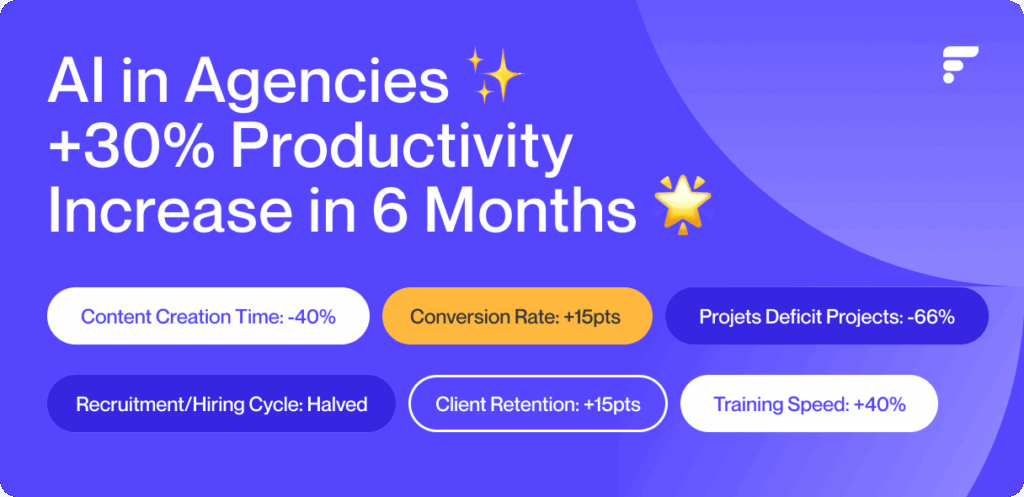
The result? Your customer acquisition cost drops by 30%. Your conversion rate increases by 15 percentage points. Your sales team focuses on relationships rather than document production.
3: Project management shifts from Excel spreadsheets to smart copilot
The principle: Anticipate deviations rather than merely observe them.
How do you manage your projects currently? An Excel spreadsheet with the planned budget, actual time spent (when it’s reported), and a margin calculation that turns red three weeks before project completion. By then, it’s too late. The project is in deficit, the client is awaiting delivery, and you can do nothing but absorb the loss.
AI transforms reactive management into predictive management. It analyzes project progress in real-time, compares it to historical data from similar projects, and alerts you BEFORE things go off track. Not after. Before.
Let’s take a practical example. You sell a website for €30,000 with a budget of 200 hours. After 6 weeks, you’ve consumed 120 hours and delivered 40% of the project. You think you’re on schedule. AI, however, detects a pattern: on your last 50 similar web projects, when the time spent/progress ratio reaches this level halfway through, the average final overrun is 35%.
It alerts you: “This project will consume 270 hours instead of 200. Estimated budget deviation: €4,900. Recommended actions: renegotiate the scope, invoice an addendum for additional features, or reassign a junior resource to the remaining tasks.”
You still have 8 weeks to act. You can call the client, discuss an addendum, and readjust expectations. The project remains profitable. Without AI, you would discover the problem in week 12, when it was too late.
What actually changes
First benefit: you detect deviations in real-time. No more waiting for the end-of-project review to discover you’ve lost €8,000. You know it by week 3, when you can still correct the course.
Second benefit: you optimize resource allocation. AI tells you: “This project can be managed by a mid-level profile rather than a senior one, estimated savings: €2,400.” Or: “This sprint requires reinforcement, otherwise there’s a risk of a 2-week delay.”
Third benefit: you capitalize on your historical data. Each project feeds the AI’s knowledge base. After 50 analyzed projects, it predicts with 85% accuracy the real time needed for each type of deliverable. Your estimates become precise.
The management workflow becomes proactive:
Continuous Monitoring : AI continuously scans the progress of all your ongoing projects. It compares budgeted time vs. time spent, progress speed, client approval rate, and milestone adherence.
Predictive Alerts : As soon as a discrepancy arises, AI notifies you. Not a weekly report that no one reads. A real alert: “Project X: 25% overrun risk, action required within 48 hours.”
Actionable Recommendations : AI doesn’t just flag the problem. It suggests solutions: reallocate resources, renegotiate the scope, invoice an addendum, or adjust the schedule.
The result? You go from 15% of loss-making projects to 5%. Your operating margin increases by 8 percentage points. Your project managers sleep better at night.
4: Recruitment becomes objective rather than intuitive
The principle: Evaluate real skills, not just a well-written resume.
Let’s be honest: how do you recruit today? You publish an ad, you receive 150 resumes, you skim through 30 of them, you select 5 that “look good,” you conduct 3 interviews, and you choose the one you clicked with.
The problem? You just spent 12 hours sorting resumes. You probably discarded excellent candidates because their resume was poorly formatted. You may have hired someone who knows how to sell themselves but won’t be able to deliver. And in 3 months, if it doesn’t work out, you’ll start over.
AI radically changes this process. It analyzes 150 resumes in 3 minutes. It identifies key skills, not just the presentation. It identifies subtle signals: this candidate changed companies 5 times in 3 years (turnover risk); this other one has progressed steadily in environments similar to yours (strong candidate).
Even better: it automatically generates personalized interview questions for each candidate, based on their specific background. No more generic questions like “What are your strengths and weaknesses?” that all candidates have prepared for. These are real questions that test expertise.
And it doesn’t stop there. It writes your job descriptions, optimized to attract the right candidates. It automates candidate follow-ups. It synthesizes interview feedback from your colleagues for an informed collective decision.
What actually changes
First benefit: you reduce the time spent on sourcing by 75%. The 12 hours of resume sorting become 3 hours of targeted interviews. Your recruitment cost drops, and your hiring quality improves.
Second benefit: you reduce bias. AI is not influenced by school names, gender, or apparent age. It evaluates objective skills. The result: you find rare gems that you would have discarded due to an atypical resume.
Third benefit: you professionalize the candidate experience. Personalized automatic responses in less than 24 hours, structured feedback after each step, and a transparent process. Candidates notice it, and your employer brand improves.
The new recruitment workflow:
Intelligent Sorting : You upload the received resumes. AI analyzes them, extracts key skills, compares them against the desired profile, and generates a matching score. You get a ranking of the top 15 profiles in 5 minutes.
Optimized Interviews : For each pre-selected candidate, AI generates a personalized interview guide. It identifies unclear areas of the resume to explore and suggests tailored situational exercises.
Informed Decision: After the interviews, AI compiles feedback from all interviewers, detects consensus and discrepancies, and highlights red flags or unanimous strengths.
The result? You halve your recruitment time. You reduce your turnover by 30% by making better hires the first time. Your managers will thank you.
With Furious, we went from a tool we had to put up with to a system that truly structures our business.
Emmanuel de Saint-Bon - Director of Roxane Agency
5: Client management shifts from artisanal to systematic
The principle: Personalize at scale what was once reserved for large accounts.
You have 50 active clients. You dream of having a personalized monthly check-in with each one. Review their business challenges, summarize the last sprint, and propose optimizations. But you don’t have 50 hours a month to dedicate to it. The result: you have quarterly check-ins with your 5 largest clients, and the other 45 receive a generic email once every six months.
They don’t feel engaged. They don’t renew their contracts. You lose 20% of your recurring revenue each year. Not because you’re doing a bad job, but because you can’t be everywhere at once.
AI solves this impossible equation. It automatically analyzes each client’s activity: ongoing projects, satisfaction level (detected through interactions), budget utilization, and red flags. And it generates a personalized monthly brief for each client.
“Client X: high satisfaction, 3 projects delivered this month, budget utilized at 65%, opportunity detected: their next product launch will require creative support, ideal time to propose a package.”
You take this brief, call the client, and have a truly valuable conversation. In 20 minutes per client, you accomplish what previously took 2 hours. You can finally follow up with all 50 of your clients monthly.
Bonus: AI also drafts your real-time meeting minutes, post-meeting follow-up emails, and project summaries. According to a study relayed by HubSpot, 30% of sales professionals already use AI to optimize note-taking and client follow-up.
What actually changes
Benefit 1: You triple the frequency of client contact without increasing your workload. Your clients feel valued and supported. Your retention rate increases by 15 points.
Benefit 2: You detect upsell opportunities. AI identifies: “This client has consumed 100% of their monthly budget for 3 consecutive months; they are ready for an upgrade.” You make the offer at the right time, and you close the deal.
Benefit 3: You anticipate churn. AI detects weak signals: decreased engagement in communications, validation delays, questions about offboarding processes. You intervene before the client leaves.
The automated client management workflow:
Relationship Monitoring : AI analyzes all client interactions (emails, tickets, transcribed calls). It detects satisfaction levels, recurring pain points, and moments of friction.
Personalized Briefs : At the beginning of each month, AI generates a brief per client: activity from the past month, key focus areas, commercial opportunities, recommended actions. Your account manager prepares their talking points in 10 minutes instead of an hour.
Follow-up Automation : After each client meeting, AI generates a structured meeting report, lists action items with owners and deadlines, and sends confirmation emails. You validate, you send.
The result? Your client retention rate increases from 75% to 90%. Your monthly recurring revenue stabilizes. You finally build true predictability.
6: Internal training shifts from one-off to continuous
The principle: transforming every employee into an augmented expert
How did you onboard your last recruit? Three days of intensive training with a senior who shows them the processes, gives them access to tools, and explains “how we do things here.” Then you throw them into the deep end, hoping they’ve retained the essentials.
Result: For 3 months, they ask their colleagues 15 questions a day. “Where’s the proposal template again?”, “How do we manage amendments?”, “Who approves supplier purchases?” Your seniors spend 30% of their time answering recurring questions. Your new recruit feels like they’re bothering people. Nobody is happy.
AI changes everything. You give them access to an intelligent knowledge base: all your processes, templates, client cases, and feedback. But not a dusty wiki that nobody reads. A conversational AI that responds in context.
Your recruit wonders how to manage an amendment? They ask the AI: “How do I manage an amendment to add 3 days of development to a web project?” AI responds: “Here is the amendment template, pre-filled with standard elements. The 3 points to check: (1) remaining client budget, (2) dev team availability, (3) formal validation before starting. Here are the last 2 similar amendments for reference.”
Even better: AI detects recurring questions and automatically generates training modules. It identifies: “15 people asked questions about the invoicing process this month; there’s a knowledge gap.” It creates a 10-minute mini-module, you validate it, and everyone improves their skills.
What actually changes
First benefit: You reduce onboarding time by two-thirds. Your new recruit is autonomous in 3 weeks instead of 3 months. They no longer bother seniors every 10 minutes.
Second benefit: You capitalize on expertise. Every problem solved, every best practice, every piece of feedback feeds the knowledge base. Your collective expertise becomes accessible to everyone, not just the old-timers who “know.”
Third benefit: You keep your skills up to date. A new process? AI automatically generates the associated training module. A new tool feature? It produces the user guide. No more excuses not to train.
The continuous skill development workflow:
24/7 Intelligent Assistant : Every employee has access to AI that knows all your processes. Question asked, contextual answer in 30 seconds. With the right templates, the right references, and the right contacts if human help is needed.
Gap Detection : AI analyzes questions asked, identifies recurring topics, and alerts: “20 questions on the same topic this month, training recommended.” It even generates the training content.
Continuous Assessment : AI regularly offers short quizzes on key processes. It detects who masters what, and who needs a refresh. Your training plan becomes data-driven rather than intuitive.
The result? Your employees improve their skills 40% faster. Your seniors reclaim 25% of their time. Your service quality becomes standardized across the entire agency.
How to Take Action (Without Failing)
These six workstreams are not science fiction. They are real transformations, implemented by real agencies, with measurable results. BCPE recorded 30% gains in creativity and productivity thanks to AI. Developers with GitHub Copilot code 55% faster. Consultants with ChatGPT deliver 40% faster with better quality.
But beware: implementing AI in an agency isn’t just about subscribing to ChatGPT and hoping for magic. It’s a true transformation project that impacts your processes, skills, and culture.
The Three Pitfalls to Absolutely Avoid
Pitfall 1: Spreading yourself too thin. You want to do everything at once: content, recruitment, management, CRM. Result: nothing is truly implemented, your teams are lost, and you give up after 3 months. Choose ONE workstream. The one that hurts the most. Succeed at it. Then move on to the next.
Pitfall 2: Neglecting change management. You deploy AI without training, without support, without explanation. Your teams resist, sabotage, and revert to old habits. AI isn’t magic; it requires new practices. Train. Support. Celebrate early wins.
Pitfall 3: Believing AI replaces humans. AI is a co-pilot, not an autopilot. It amplifies your expertise; it doesn’t replace it. A writer with AI is worth 2 writers. But a non-writer with AI remains a non-writer. Invest in skills, not just tools.
Where to Start Tomorrow Morning
Identify your priority workstream. The one that costs you the most money or time. Does content production consume 40% of your capacity? Start there. Does recruitment take 3 months and you fail half the time? Tackle that front.
Launch a 4-week pilot. Not a general deployment. A test with 2-3 volunteers in a limited scope. Measure real gains: time saved, improved quality, team satisfaction.
Document what works and what doesn’t. Adjust your processes. Train the rest of the team. Deploy gradually. Move to the next workstream when the first is stabilized.
In 6 months, you won’t recognize your agency. Your teams will deliver 30% faster. Your projects will be profitable from day one. Your clients will be better supported. Your recruitment will be more efficient. Your collective expertise will be accessible to everyone.
Meanwhile, your competitors will still be wondering if AI “is really for us.”
Discover how Furious integrates AI to manage your agency →
You may be asking yourself these questions?
01 Which AI initiative should my agency prioritize?
Identify your main pain point. If you spend 40% of your time on content creation, start there. If your sales conversion rate is low, tackle pre-sales. If your projects consistently go off track, manage them with AI. The rule: one initiative at a time, tested over 4 weeks with 2-3 volunteers, measured, then deployed. No big bang, just iterative.
02 Will AI replace my team members?
No, it augments them. A writer using AI produces 40% faster with better quality. But a non-writer using AI remains a non-writer. AI handles the heavy lifting (structure, first draft, research), while humans provide expertise, nuance, and personality. Result: your teams increase productivity by 30%, not unemployment. They create more added value, fewer repetitive tasks.
03 What is the real cost of implementing AI in a 30-50 person agency?
Realistic budget: between €15,000 and €40,000 for the first year (tool licenses + training + support). But the ROI is fast: every dollar invested yields $3.7, according to studies. For a content initiative, for example, you save 50% of production time, equivalent to recovering 0.5 FTE (approximately €25,000/year). The investment pays for itself in 6-12 months.
04 How to manage team resistance to AI?
Three levers: (1) Train before deploying – your teams fear what they don’t understand, (2) Involve enthusiastic early adopters who will evangelize to others, (3) Celebrate visible quick wins (“Since we started using AI, Marie delivers her briefs in 2 hours instead of 5”). Resistance often comes from the fear of being replaced. Quickly prove that AI makes them better, not obsolete.
05 What legal and ethical risks should be monitored with AI?
Three areas of vigilance: (1) Intellectual property – never publish 100% AI-generated content without human review, (2) Confidentiality – never feed sensitive client data to AI without consent, (3) Algorithmic bias – ensure that recruitment AI does not discriminate against certain profiles. Advice: define a clear AI usage charter, train your teams, and designate a reference person to validate sensitive use cases.