


 Auteur vérifié
In summary:
Thanks to these 5 KPIs:
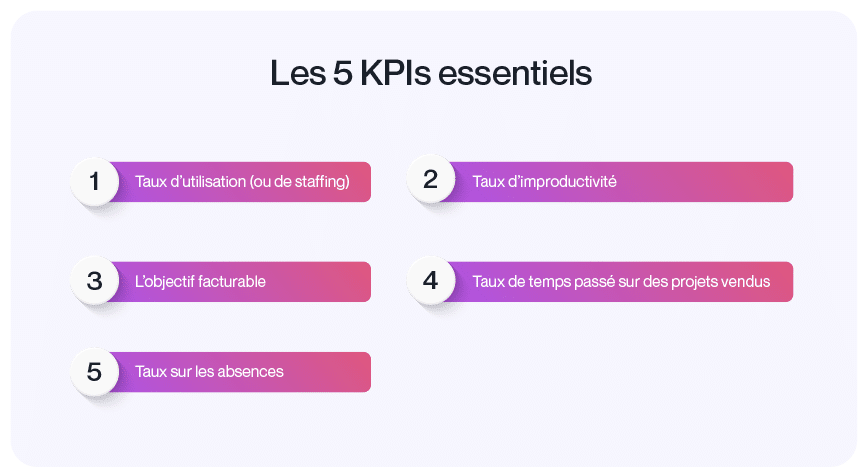
Managing staffing at an agency without KPIs is like moving forward without a compass. Allocate too many resources, and your profit margin plummets. Allocate too few, and your teams burn out or your projects fall behind schedule. Fortunately, there’s a reliable compass: staffing KPIs. With them, you can maximize profitability while retaining your talent. In this article, we’ll look at the five must-have KPIs.
Without clear metrics, you expose your agency to several major risks:
These pitfalls not only jeopardize your agency’s financial performance, but also the well-being of your employees. In contrast, management based on relevant KPIs paves the way for overall optimization. Let’s explore them in detail.
The utilization rate measures the actual workload relative to your teams’ total available capacity. It is a crucial metric for preventing situations of overwork or underutilization that can negatively impact your agency’s overall performance.
This KPI helps identify:
Why is this important?
A rate that is too high leads to overloads, while a rate that is too low results in underutilization of resources and financial losses.
How can I follow him?
Expected impact: Balanced workload management improves employee productivity, reduces the risk of burnout, and maximizes the efficient use of resources, while increasing overall profitability.
A company wastes 11.4% of its resources due to poor project management.
This KPI measures non-billable time or time spent on internal tasks. It highlights inefficiencies in time management and prioritization.
This KPI helps identify:
Why is this crucial?
Reducing unproductive time helps maximize billable time and improve profitability.
How can you track and optimize it?
Expected Impact: By reducing non-billable tasks, you can focus your teams’ efforts on value-adding activities, which improves margins and increases employee satisfaction.
The billable target allows you to set a target percentage of billable time per employee and compare it to actual performance. This metric is crucial for assessing whether resource allocation remains aligned with the agency’s financial goals.
This KPI helps identify:
Why is this crucial?
A realistic billable target ensures that employees remain focused on high-value-added tasks. If the actual billable rate falls short of the target, this leads to higher costs per employee and increased pressure on overall profitability.
How can I follow him?
Expected Impact:
A well-monitored billable target helps maintain project profitability, prevent an increase in operating costs, and ensure optimal allocation of resources to strategic initiatives.
Thanks to proactive resource planning and more accurate estimates of time spent on each project, the agency has not only improved its profitability tracking but also saved 5 hours per week. This significant improvement was made possible by using Furious.
Caroline Vignand, Associate Director, POP FOR YOU (Humanskills Group)
This KPI measures the proportion of time your teams spend on billable projects, relative to the total number of hours worked.
This KPI helps identify:
Why is this crucial?
This KPI helps ensure that the time employees invest generates maximum value for the agency.
How can I follow him?
Expected Impact:
Better management of this KPI will allow you to increase the productive time allocated to client projects, improve the profitability of each assignment, and maximize the use of your employees’ skills.
The absenteeism rate measures the impact of absences (vacation, sick leave, turnover) on the agency’s overall productivity. This KPI should not be limited solely to occasional absences, but should also take into account the effects of employees leaving and joining the company, which can affect the continuity of projects.
This KPI helps identify:
Why is this crucial?
Accurate tracking of absences and transitions helps prevent disruptions to projects, anticipate peaks in activity, and reduce the workload on the remaining teams. Poor management of these phases can delay projects and affect customer satisfaction.
How can you track and optimize it?
Expected Impact: By integrating absence management and transition planning, you minimize disruptions to your projects, ensure production continuity, and reduce the workload on your teams. This helps strengthen your organization’s resilience in the face of staff turnover.
Effective KPI tracking starts with the proper adoption of tools and practices. Teams that understand the importance of KPIs are more committed to tracking and meeting them.
Practical tip: Schedule regular meetings to share performance metrics and explain how the data influences your decisions. Collective buy-in strengthens team dynamics.
Working with KPIs scattered across multiple files or tools is like putting together a puzzle with missing pieces. Effective centralization allows you to view the status of your resources in real time.
How do I do that?
Use a single platform to collect, analyze, and share your data in real time. Set up customizable dashboards that are accessible to all managers.
Impact: You gain greater visibility and can make informed decisions quickly.
Manually tracking KPIs is time-consuming and prone to errors. Automation allows you to devote your time to strategic tasks.
How do I do that?
Impact: You save time and improve the reliability of your analyses.
(With Furious, dashboards update automatically based on the data entered by your teams. You even receive alerts to help you anticipate overloads or imbalances.)
Effective management doesn’t stop at the present—it looks toward the future. With forecasting tools, you can anticipate future needs and allocate your resources more effectively.
How do I do that?
Impact: You reduce unforeseen issues and optimize your schedules.
KPIs aren’t set in stone. Your agency’s needs change, and your metrics must adapt to remain relevant.
Our tip : After each project, hold a debriefing to analyze what worked (and what didn’t) and adjust your methodologies. This will help you maintain an agile and effective management approach.
Tracking these KPIs empowers your agency to effectively manage its staffing while maximizing its profitability.
With Furious, you can view these KPIs in real time. Thanks to clear dashboards and automatic alerts, you can turn your data into informed decisions. The result: greater visibility, less stress, and an agency that stays on track for growth.
Don’t let KPIs be just numbers—turn them into strategic drivers of your success.
Book your free demo now and discover how to manage your agency with confidence and efficiency.
The frequency depends on the nature of the agency, its size, its production pace, and the volatility of its projects. For example, in a very dynamic agency or one that manages many short-term projects, weekly monitoring of metrics such as the utilization rate can be useful. On the other hand, more strategic KPIs (profitability, margin, turnover) can be tracked monthly or quarterly to identify trends. The key is to be consistent and to be able to react quickly enough if a deviation is detected.
This is a common situation. KPIs are interdependent: for example, a high utilization rate (good) may go hand in hand with a high burnout rate or a decline in quality if teams are overloaded (bad). In this case, you need to dig deeper: understand the causes, adjust resources or processes, and rebalance the workload. The goal isn’t to optimize a single metric in isolation, but to achieve a balance so that the overall system remains healthy.
According to the agency, we could consider adding KPIs such as:
Cost of skills (actual cost of internal and external resources allocated to a project)
Lead/prospect conversion rate if the agency handles a lot of pre-sales work
Customer satisfaction (or Net Promoter Score) to assess perceptions of the service provided
Turnover or retention rates for internal employees (and external employees, if applicable)
Average billing cycle / payment terms, if this has a significant impact on cash flow.
Some best practices:
Use tracking tools (project management software, ERP, time-tracking systems) that centralize data.
Ensure that all members record their work hours and tasks regularly and accurately.
Clearly define what is “billable” versus “non-billable,” what constitutes “productive time,” and so on, in a consistent manner across the agency.
Check historical data for anomalies or data entry errors.
Automate data reporting (alerts, dashboards) as much as possible to minimize data loss or corruption.
Here is one possible approach:
Diagnose: Identify exactly which indicator(s) are causing problems, and when (assignments, teams, clients, type of task).
Involve the relevant parties—project managers, human resources, and operational staff—to understand the causes.
Test corrective actions: rebalance workloads, reallocate certain non-productive tasks, adjust the schedule, provide training, hire, and delegate.
Set up secondary metrics and alerts to monitor the impact of changes.
Review regularly (for example, after a month or a quarter) to see if the measures are effective or if other measures should be tested.
The frequency depends on the nature of the agency, its size, its production pace, and the level of volatility in its projects. For example, in a very dynamic agency or one that manages many short-term projects, weekly monitoring of metrics such as the utilization rate can be useful. On the other hand, more strategic KPIs (profitability, margin, turnover) can be tracked monthly or quarterly to identify trends. The key is to be consistent and to be able to react quickly enough if a deviation is detected.
This is a common situation. KPIs are interdependent: for example, a high utilization rate (good) may go hand in hand with a high burnout rate or a decline in quality if teams are overloaded (bad). In this case, you need to dig deeper: understand the causes, adjust resources or processes, and rebalance the workload. The goal isn’t to optimize a single metric in isolation, but to achieve a balance so that the overall system remains healthy.
According to the agency, we could consider adding KPIs such as:
Cost of skills (actual cost of internal and external resources allocated to a project)
Lead/prospect conversion rate if the agency handles a lot of pre-sales
Customer satisfaction (or Net Promoter Score) to assess perceptions of the service provided
Turnover or retention rates for internal employees (and external employees, if applicable)
Average billing cycle / payment terms, if this has a significant impact on cash flow.
Some best practices:
Use tracking tools (project management software, ERP, time-tracking software) that centralize data.
Ensure that all members record their work hours and tasks regularly and accurately.
Clearly define what is “billable” versus “non-billable,” what constitutes “productive time,” and so on, in a consistent manner across the agency.
Check historical data for anomalies or data entry errors.
Automate data reporting (alerts, dashboards) as much as possible to minimize data loss or corruption.
Here is one possible approach:
Diagnose: Identify exactly which indicator(s) are causing problems, and when (assignments, teams, clients, type of task).
Involve the relevant parties—project managers, human resources, and operational staff—to understand the causes.
Test corrective actions: rebalance workloads, reallocate certain non-productive tasks, adjust the schedule, provide training, hire, and delegate.
Set up secondary metrics and alerts to monitor the impact of changes.
Review regularly (for example, after a month or a quarter) to see if the measures are effective or if other ones should be tried.