
All ERP promise the same thing: time savings, renewed visibility, improved profitability. Sales brochures are full of impressive percentages and attractive promises.
But how many hours are really ? What measurable impact on your profitability? What concrete difference in your daily operations?
To answer these questions, we asked five agency and consulting firms to open their Furious dashboards. No marketing talk. Just real numbers, measurable gains, lived transformations.
The protagonists:
- Lou Van Assche, Operations Director at KOHE
- Pascal VanBerten, Associate Director at Progress Partners
- Shirley Jagle, Founder of Kairos
- Amaury Bataille, CEO of Monet
Here’s what they gained. For real. With the numbers.

Time regained: from several days to a few hours
Invoicing that no longer causes stress
Invoicing is the lifeblood of any business. Yet, in most agencies, it’s also a time sink. Manual exports from three different tools, data consolidation in Excel files that crash at the wrong moment, manual client reminders…
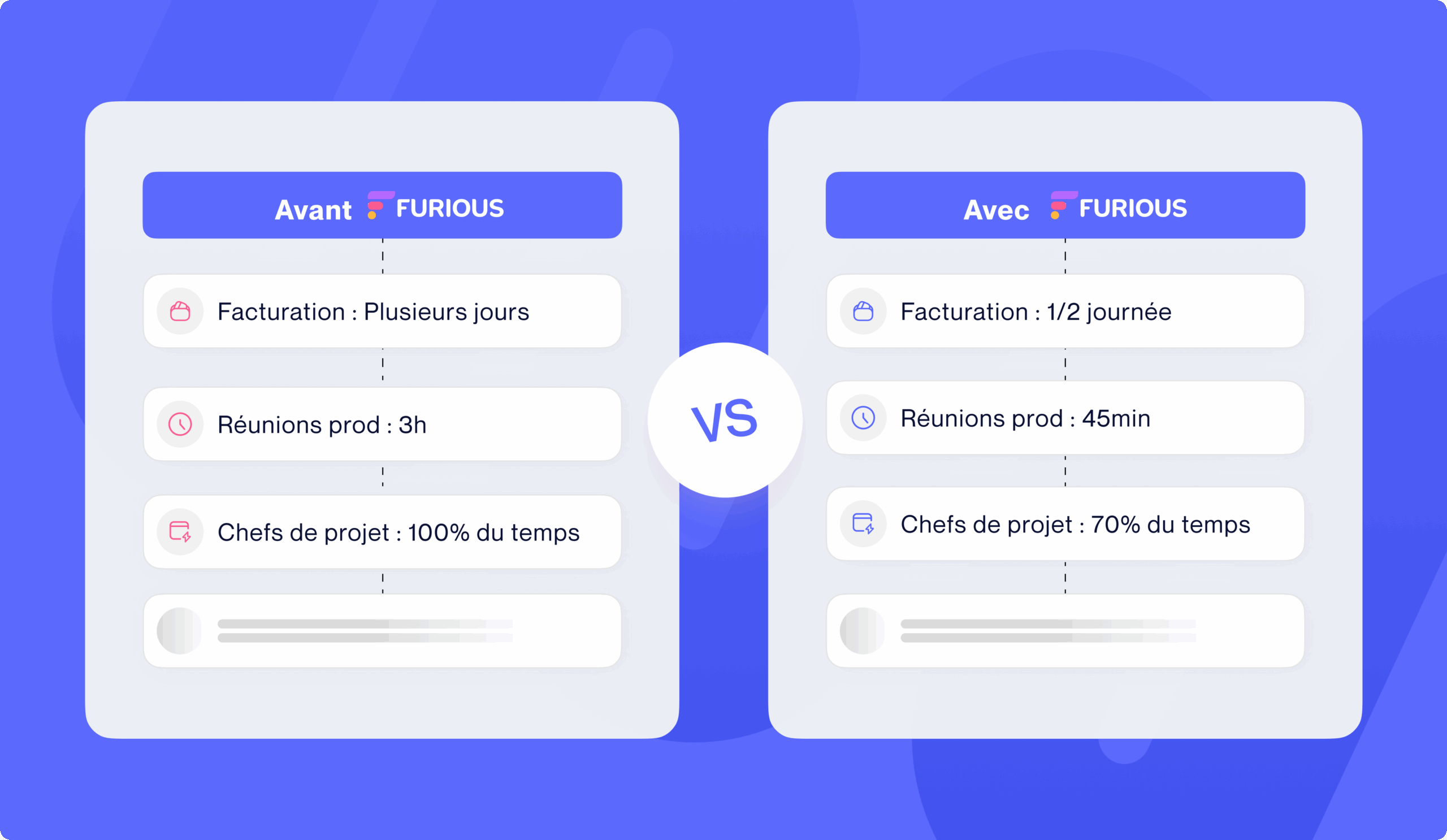
Lou Van Assche (KOHE) doesn’t mince words : “We went from several days of invoicing to half a day per month. And most importantly, without stress.” Several days. Half a day. Do the math: that’s between 70% and 90% time saved on a task that comes back every month.
It’s not just time saved. It’s less stress, fewer errors, better cash flow management. Lou confirms: “What was a constant source of tension has become a formality. We’ve regained control of our management.”
The takeaway : Between 70% and 95% time saved on invoicing and administrative tasks. Not 10%. Not 20%. We’re talking about dividing the time spent by 5 to 20.
Schedules that (almost) create themselves
Agency means planning. And scheduling often means nightmare. Shared Excel files where three people write at the same time, duplicate entries between the project management tool and the schedule, production meetings that drag on because no one has the same version of the truth…
Shirley Jagle (Kairos) timed it: “I estimate it saved me about 30% of time on all project manager positions. Scheduling takes me three times less time because it’s already pre-filled.”
30% on all project manager positions. Three times less time on scheduling. In a 10-person agency with 3 project managers, we’re talking about recovering the equivalent of a half-time position.
At J’articule, Estelle, office manager, testifies: production meetings went from 3 hours to 45 minutes. And most importantly: “No one leaves angry anymore.” Time saved is good. Regained serenity is better.
Caroline Vignand-Olivier, associate director at Pop For You, did her calculations: “Using Furious saves me about 5 hours a week.” Five hours. Per week. Over a year, that’s 260 hours. More than a month and a half full-time.
The takeaway : 30% to 70% of time saved on operational management. A month and a half per year recovered to do something other than reporting.
From rearview mirror to real-time GPS
There’s a fundamental difference between noticing that a project has gone off track and seeing it coming . Between driving by looking in the rearview mirror and having a GPS that warns you 5 km before the turn.
Amaury Bataille (Monet) explains it simply: “It allows us to manage our business and make people work together. We have KPIs that allow us to see where we stand at a glance.”
Matthieu Didailler (Insign) uses a telling metaphor: “Before, it was like taking pictures. We looked at the situation after the fact, in the rearview mirror. With Furious, we can now anticipate and project ourselves into the future thanks to real-time planning.”
Harold Gardas, CEO of Köm Média, doesn’t even pick up the phone anymore: “I no longer need to ask my directors, I directly consult my dashboard and have a clear view of everything.”
The takeaway : Transition from reactive management (we notice the problem when it’s too late) to anticipatory management (we see it coming and act before). It’s the difference between putting out fires and preventing them from starting.
Profitability unlocked: money no longer going up in smoke
The 30% of invoices that are no longer lost
Let’s talk cash. How many missions do you actually invoice compared to what you should invoice? If you don’t know this figure, you probably have a problem.
Pascal VanBerten (Progress Partners) had a big problem : “Before, we were losing 30% of invoices and 80% of time-and-materials projects weren’t being invoiced.” Read that sentence again. 30% of invoices. 80% of time-and-materials projects. That’s your money going straight into the trash.
“With Furious, everything recorded is invoiced, which has increased our revenue. Today, only 9% of invoices remain unpaid thanks to automation.”
From 30% loss to 9% unpaid. That’s 21 percentage points recovered. For a firm with €500K in revenue, that represents €105K going into the coffers instead of evaporating.
Nicolas Quilliet (Wokine) worked from another angle: “We managed to halve the invoices awaiting payment, so as not to exceed one month of outstanding revenue.”
Halving your working capital requirement means halving the risk of cash flow strain. It also means halving the immobilized money that isn’t working for you.
The takeaway : Up to 30% of revenue recovered + drastic improvement in working capital requirements. According to industry studies, service companies that do not precisely track their billable hours can lose up to €50,000 in annual revenue per employee.
Projects saved at the last minute
Do you know this feeling? A project that was supposed to be profitable, a happy client, everything seems to be going well… and three months after delivery, you realize you lost money on it. Except it’s too late to do anything about it.
Shirley Jagle (Kairos) changed her approach: “The KPI I prioritize is the margin. It allows me to ensure that we don’t exceed the time allocated in the quotes. If we exceed it, I either discuss it with the client or adjust the next quote to avoid making the same mistake.”
Real-time margin tracking is not a luxury. It’s the difference between discovering you lost €15K on a project six months after it ended, and being able to react during the project.
Vincent Tenenbaum (Fidesio) can testify: “We reacted in real time to a mission that was going haywire. It saved our margin and triggered a overhaul of our pricing structure.”
Alexandre Ayme (Adveris) summarizes the transformation: “In our old tool, we found that the project was already in trouble. What really matters is being able to see it coming and avoid the trouble, and that’s exactly what Furious allows us to do.”
The takeaway : Early detection of deviations = preserved margins. When you invoice on a fixed-price basis, every unanticipated hour eats away at your profitability. According to industry data, agencies that don’t master their initial estimates suffer an average erosion of 25% to 35% on actual operating margin.
Revenue that doubles (and remains profitable)
Growth is good. Profitable growth is better. Many agencies experience the painful reality of uncontrolled growth: revenue increases, teams grow, but strangely, there isn’t more money left at the end of the month.
Amaury Bataille (Monet) has a telling anecdote: “We’ve been using Furious for a little over two years now. Since we installed Furious, we’ve doubled our revenue in two years.”
Doubled. In two years. But that’s not all: “We implemented purchase management, which allows us to see the gross margin profitability per project automatically. We can aggregate our gross margin estimates, both on actuals and forecasts. We couldn’t do without our gross margin estimate, which we track almost daily.”
Revenue x2, but with daily profitability tracking. That’s the whole difference between growing and developing.
Michael Illouz (Conceptory) confirms: “Since we started using Furious, our projects are becoming more and more profitable, thanks in particular to the reports and the back-office. For invoicing and cash flow, it’s also much clearer.”
Harold Gardas (Köm Média) uses this visibility to steer: “Furious helps us identify profitable projects through an audit with client KPIs, which allows us to know where to intensify our commercial efforts.”
The takeaway : Controlled and profitable growth. Not just revenue for revenue’s sake. Revenue that actually converts into cash flow and profit. According to a 2017 Sage study, SMEs lose an average of 142 days per year on administrative tasks that could be automated.
Regained visibility: finally knowing what’s happening
When everyone has access to the same information
In many agencies, there are “those who know” and “those who execute.” Information is centralized on one or two people. If these people are absent or overwhelmed, everything stops. And most importantly, it creates silos, misunderstandings, and friction.
Jérôme Balmain (La Haute Société) describes the before and after: “Before Furious, information was centralized on one person and we didn’t give visibility to everyone. Today, we can see each employee’s schedule; everyone has access to information without having to ask. The major time saving is on shared schedules. This has decentralized the role of the production director: today, project managers can directly manage adaptations.”
Véronique Gervais (O2M) confirms: “All project-related information is centralized and shared. This strengthens consultants’ autonomy and streamlines exchanges.”
The takeaway : Decentralization of information = increased autonomy + fluid collaboration. When everyone works on the same real-time database, there are no more contradictory versions, no more “I thought that,” no more double work.
Serenity returns
There are measurable gains in euros and hours. And then there are the “invisible” gains that change everything: reduced mental load, fading stress, teams breathing easier.
Lou Van Assche (KOHE) states it clearly: “Furious is the first time a tool truly matches our way of working. We don’t adapt to it; it adapts to us.”
Shirley Jagle (Kairos) noticed the effect from the first week: “We gained serenity very quickly. Already after a week, we had more visibility.”
At J’articule, the change is striking according to Estelle: “No one leaves production meetings angry anymore.” When your production meetings no longer end in a brawl, something has fundamentally changed.
Vincent Tenenbaum (Fidesio) describes the transition from one mode of operation to another: “We are less reactive and more anticipatory. And that changes everything in daily stress.”
The takeaway : Preserved workplace well-being = sustainable teams. Turnover is expensive, very expensive. According to HR studies, replacing a manager costs between 6 and 9 months of salary. Keeping your teams calm and engaged isn’t just a plus. It’s a profitability issue.
Why it works (and why it might not)
Rapid adoption: when the tool doesn’t fight users
An ERP, however powerful, is worthless if no one uses it. How many companies have bought licenses for tools that remained deserted after three months of trial?
Lou Van Assche (KOHE) found the difference: “Furious is the first time a tool truly embraces our way of working. We don’t bend to it; it adapts to us.”
Estelle (J’articule) noticed the effect from the first week: “Three months after deployment, Furious was already part of the team’s reflexes. Today, we couldn’t do without it.”
Laurent Kretz (Cosa) explains what makes the difference: “What convinced us? Furious speaks our language. It’s designed for agencies, by people who understand our real constraints.”
The key point : A tool designed BY agencies FOR agencies. Not a generic ERP that you try to adapt as best you can to your business. A tool that immediately understands what a daily rate, staffing, and project gross margin are.
The end of the tool pile-up
How many tools do you use today? A CRM here, a project management tool there, an Excel spreadsheet for invoicing, another for scheduling, Trello for tasks, Slack for communication, Google Drive for documents…
According to studies, service companies use an average of 7 to 12 different tools. The result: duplicates, redundant data entry, inconsistencies, and no one having a complete overview.
Amaury Bataille (Monet) describes the effect of a centralized system: “It allows us to manage our business and ensure people work together, see what’s being done, and truly gain fluidity.”
Michael Illouz (Conceptory) confirms: “Since we started using Furious, we’ve been able to do without two tools.”
Cédric Morel (Hula-Hoop) summarizes: “Before, we used several disparate tools: one for management, one for planning, and another for client relations. The real strength of Furious is that all agency activity is now centralized, top-to-bottom, giving us a real-time overview.”
The takeaway : A single central nervous system. No more double entry. No more “wait, which tool is it in again?”. No more conflicting versions of the truth. A single database, updated in real time, accessible to everyone.
Furious helps us identify profitable projects through an audit with client KPIs, which allows us to know where to intensify our sales efforts.
Harold Gardas, CEO, KÖM Media agency
Key takeaways
Measurable ROI
Let’s review the raw figures:
Time savings:
- 70% to 95% time saved on invoicing (several days → half a day)
- 30% to 70% time saved on operational management
- 5 hours recovered per week per project manager
- Production meetings cut by 75% (3 hours → 45 min)
Profitability improvements:
- Up to 30% revenue recovered from lost invoices
- 80% of managed service missions now invoiced (vs. 20% before)
- Working Capital Requirement (WCR) halved
- Revenue doubled in 2 years with controlled profitability
Visibility enhancements:
- Shift from post-mortem management to proactive management
- Decentralization of information and team autonomy
- Decisions made based on real-time data, not rough estimates
The “invisible” ROI (but just as real)
Beyond the numbers, there are gains that aren’t measured in euros but fundamentally change your daily life:
- Restored peace of mind: “What was a constant source of tension has become a formality”
- Confidence in your decisions: no more guesswork
- The ability to scale: double your revenue without losing control
- Team engagement: when tools help instead of hinder
What truly makes the difference
Not all ERPs are created equal. And more importantly, not all ERP deployments are equal. What emerges from the testimonials:
- Industry relevance: a tool designed for your industry, not a generic solution you try to adapt
- Rapid adoption: if your teams aren’t using it after 3 months, it’s a lost cause
- Centralization: a tool that replaces 3 to 5 existing tools, not just another tool
- Real-time: constantly updated data, not monthly Excel exports
- Support: a team that listens and evolves the product
The question you need to ask yourself
It’s not “Do I need an ERP?”. If you manage an agency or consulting firm with more than 5 people, the answer is probably yes.
The real question is: how much does it cost you to NOT have a suitable ERP?
- How many hours do you lose each week on double data entry, manual consolidation, and information retrieval?
- How many invoices are never issued because they fall through the cracks?
- How many projects go off track because you discover the problem too late?
- How many decisions do you make “by gut instinct” because you don’t have the numbers at hand?
Shirley Jagle had lost prospects “because she didn’t follow up with them quickly enough.” Pascal VanBerten was losing 30% of his invoices. Lou Van Assche spent several days per month on invoicing.
How much does it cost you, every month, to operate like this?
The five clients whose testimonials you’ve read are not exceptional cases. They are normal agencies and firms, with normal challenges, who chose a suitable business tool.
The results are clear. Measurable. Real. Reproducible.
It’s your turn.
Discover how Furious transforms your agency’s management
Do you want to know how much your agency could gain with industry-specific ERP? The numbers you just read aren’t promises. They’re real, measured, verifiable results.
Our team will show you in 30 minutes how Furious adapts to your context, your challenges, your processes. No commitment. No bullshit.
You may be asking yourself these questions?
01 How long does it take to see a return on investment after implementing a business ERP?
Most agencies see gains within the first few weeks. Shirley Jagle (Kairos) speaks of increased visibility “from the first week”. Gains in invoicing and administration are immediate. For full financial ROI, expect between 8 and 15 months according to industry studies, but operational benefits are felt much sooner.
02 What are the main indicators to track to measure an ERP's ROI?
Key indicators are: time saved on administrative tasks (invoicing, scheduling), the rate of lost invoices, WCR (Working Capital Requirement), the project budget overrun rate, and gross margin per project. These KPIs give you a clear view of the real impact on your profitability.
03 How do I convince my teams to adopt a new management tool?
Adoption depends on two factors: choosing a tool designed for your business (not a generic ERP) and demonstrating concrete benefits from the start. As Lou Van Assche says: “This is the first time a tool truly matches our way of working. We don’t adapt to it; it adapts to us.” If the tool genuinely simplifies their daily work, adoption happens naturally within 2-3 months.
04 What are the risks of an ERP project that doesn't deliver the expected ROI?
The main pitfalls are: choosing a solution that’s too complex or too generic, underestimating the importance of training, neglecting change management support, and not defining measurable objectives from the outset. 30% of ERP projects fail to meet their objectives, mainly due to poor business fit or insufficient team adoption.